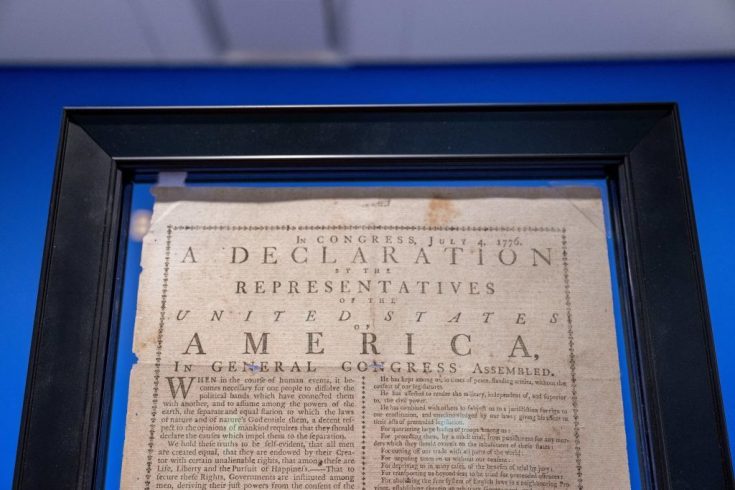


When Charles Carroll arrived in Philadelphia to represent Maryland in the Continental Congress, John Hancock asked the 38-year-old delegate if he was ready to sign the Declaration of Independence.
“Most willingly,” Charles replied, to which a bystander reportedly remarked, “There go a few millions.”
The anecdote, which first appeared in an early 19th-century biography of the Declaration’s signers, is likely apocryphal, but gained traction as a believable assessment of the risk Charles Carroll of Carrollton assumed by inking his name on the parchment.
Though largely forgotten by history, Charles Carroll was the longest-living signer and had perhaps the most to lose of the 56 men who pledged their lives, fortunes and sacred honor to the cause of independence. Boasting wealth equivalent to approximately $325 million today, he was reputedly the richest man in the colonies when they broke from Great Britain.
As the only Roman Catholic signer, Carroll also had much to gain for himself and his posterity by advocating the importance of religious liberty in the new American republic.
‘Anywhere so long as there be freedom’
Born Sept. 19, 1737, in Annapolis, Charles Carroll of Carrollton bore the name of both his father, Charles Carroll of Annapolis, and his grandfather, Charles Carroll the Settler, who immigrated to Maryland in 1688 to escape English persecution against Roman Catholics in Ireland after the Glorious Revolution.
Though originally founded by the Catholic Calvert family as a haven of religious toleration, Maryland became one of the least tolerant colonies for Catholics after its so-called Protestant Revolution overthrew the Catholic proprietary government in 1689.
Anti-Catholic “penal laws” followed, stripping Catholics of the right to vote, hold office, practice law, worship publicly, or educate their children in their faith. They faced double taxation on land and were reduced to conducting Mass in secret. Within months of arriving to serve as Maryland’s attorney general, Charles’ grandfather was stripped of his title and imprisoned for refusing to renounce his Catholic faith.

After Charles was sent to Europe at age 11 to receive the rigorous Jesuit education that was illegal in Maryland, his father would write to remind him of the “ill treatment” his grandfather had endured and the injustice that still prevailed in his native country.
Charles’ father briefly considered escaping Maryland to the western frontier, and the family reportedly considered a motto reflecting their desire for liberty: “Anywhere so long as there be freedom.”
First Citizen
After returning to Maryland following 16 years abroad, Charles first emerged publicly amid rising tensions with the British in the 1770s with a series of influential essays in the Maryland Gazette. In a nod to his inability to hold public office as a Catholic, he wrote under the pseudonym “First Citizen,” debating British policies with a Loyalist member of the Maryland General Assembly.
His opponent’s tactic of attacking Charles personally as a “Papist” backfired with the public, boosting his popularity while highlighting the religious discrimination prevalent within the royal government. Charles became a formidable advocate for liberty, serving on Maryland’s committees of correspondence and safety, which ultimately seized control of the colony from royal officials.

Elected to represent Maryland in the Continental Congress on July 4, 1776, Charles was too late to vote for independence, but signed his name to the Declaration on Aug. 2. He had already been playing a leading role in Maryland’s independence and would serve on the committee to draft the state’s new Declaration of Rights and constitution later that summer.
Using language echoed in the Declaration of Independence, Maryland’s declaration argued that self-government was an “inherent and unalienable right,” and bemoaned Parliament’s “steadied system of oppression” that had exploded into an unjust war against the colonists.
The Maryland Declaration of Rights also broke from the Church of England, establishing freedom of worship for all Christians there, including Roman Catholics. Promising “all persons professing the Christian religion are equally entitled to protection in their religious liberty,” the provision formally restored religious liberty to Catholics in Maryland for the first time since the days before Carroll’s grandfather was jailed.
‘The basis of every virtue’
Religious liberty was foundational to Carroll’s political aims, and in several letters he made clear that it had propelled his support for the patriot cause. Though he did not take part in the 1787 Constitutional Convention, he backed the Constitution’s ban on religious tests for office as well as the protections that would become the First Amendment.
“To obtain religious, as well as civil liberty, I entered zealously into the Revolution, and observing the Christian religion divided into many sects, I founded the hope that no one would be so predominant as to become the religion of the State,” he wrote to a prominent Baptist minister in 1827.

“That hope was thus early entertained, because all of them joined in the same cause, with few exceptions of individuals. God grant that this religious liberty may be preserved in these States, to the end of time, and that all believing in the religion of Christ may practice the leading principle of charity, the basis of every virtue,” he added.
Despite the persecution his family had endured and the discrimination that lingered against him even when he served as one of Maryland’s first two representatives in the U.S. Senate, Carroll exhibited charity toward Protestants, writing that he feels “no ill will or illiberal prejudices” against them and anticipates they will go to Heaven “if their lives be conformable to the duties and morals prescribed by the gospel.”
In an 1829 letter to George Washington Custis, Carroll wrote: “When I signed the Declaration of Independence, I had in view not only our independence of England but the toleration of all Sects, professing the Christian Religion, and communicating to them all great rights. Happily this wise and salutary measure has taken place for eradicating religious feuds and persecution.”
‘The best earthly inheritance’
Charles would live for another half-century after the end of the American Revolution, later resigning from the federal government to continue serving in the Maryland Senate until he retired from political life after losing his seat in 1800.
As he tended to his extensive property over the next 30 years, Charles became an enduring symbol of the founding generation as he discerned troubling political trends for his country.
While owning many slaves himself, he saw the institution as “a great evil” and introduced failed legislation to gradually abolish it in Maryland. He viewed with concern the anti-Christian influence of the French Revolution on figures such as Thomas Jefferson, whose deism he opposed. He took issue with the Declaration’s author for supporting Thomas Paine’s “blasphemous writings against the Christian religion,” according to a private letter he wrote in 1802.
When both Jefferson and John Adams died on July 4, 1826, Charles seemingly sensed the gravity of his role as the last surviving signer. In a testament he scrawled that day on the back of a parchment copy of the Declaration, he commemorated its 50th anniversary by rededicating the document and its ideals to the God of Christianity.
Expressing gratitude “to Almighty God for the blessing which, through Jesus Christ our Lord, he has conferred upon my beloved country, in her emancipation, and upon myself, in permitting me, under circumstances of mercy, … to survive the fiftieth year of American Independence,” Charles went on to pen a message to posterity.
“I do hereby recommend to the present and future generations the principles of that important document as the best earthly inheritance their ancestors could bequeath to them, and pray that the civil and religious liberties they have secured to my country may be perpetuated to the remotest posterity and extended to the whole family of man.”
‘My fervent prayer’
For all his worldly accomplishments and temporal fortune, Charles’ mind was fixed on eternity and the importance of godliness as he reached the end of his life, which extended long enough for him to lay the first stone of the Baltimore and Ohio Railroad in 1828.
“I have lived to my ninety-sixth year,” he reflected to his confessor. “I have enjoyed continued health, I have been blessed with great wealth, prosperity, and most of the good things which the world can bestow — public approbation, esteem, applause. But what I now look back on with the greatest satisfaction to myself is, that I have practiced the duties of my religion.”
Charles died, aged 95, on Nov. 14, 1832, refusing any further food and drink after receiving the Eucharist on his deathbed. The nation mourned their last living link to the Declaration of Independence, with one Baltimore newspaper announcing: “A great man hath fallen in Israel!” Another eulogized him as “the last of the Romans,” a classical allusion to describe a figure whose death marks the end of bygone virtue.

Charles’ later years were stricken by grief at the behavior of Charles Carroll Jr., his only surviving son, who squandered his hefty allowance of the family fortune, destroyed his marriage and struggled severely with alcoholism, reportedly drinking up to two quarts of hard liquor daily.
Before his son predeceased him in 1825 by succumbing to cirrhosis at age 50, Charles penned him anguished letters for years, urging him to repent. In a letter written in 1813, he noted that humility and gratitude before God was the only remedy to the self-destructive sin that was enslaving him.
He exhorted him “never rise or go to bed without humbling yourself in fervent prayer before your God, and crave his all powerful grace to overcome your vicious and intemperate habit.” In a similar letter written shortly before Easter in 1821, Charles expressed his hope in “the merits and mercies of our Redeemer,” which he described to his son as “a happiness I wish you to participate with me by infusing into your heart a similar hope.”
“Should this letter produce such a change it will comfort me, and impart to you that peace of mind, which the world cannot give, and which I am sure you have long ceased to enjoy,” he wrote.
Personal righteousness had national implications in Carroll’s worldview. Though he expressed a desire in the twilight of his life that the republic established by the Declaration of Independence would long secure the blessings of liberty to posterity, he echoed the warning of John Adams that it could not sustain a people who lose their virtue.
“You observe that republics can exist, and that the people under that form of government can be happier than under any other,” he wrote to a group of working men in 1828. “That the republic created by the Declaration of Independence may continue to the end of time is my fervent prayer.”
“That protracted existence, however, will depend on the morality, sobriety and industry of the people,” he added.
Jon Brown is a reporter for The Christian Post. Send news tips to [email protected]