Key Points
- Practicing Christians are adopting AI rapidly, even while many pastors feel unprepared to guide their congregations through AI-related questions.
- The danger may not be a conscious decision to replace God, pastors, or Scripture, but a series of small habits that slowly make them seem less necessary.
- AI can reshape Christian imagination by making efficiency feel more natural than embodied dependence, patient study, and shared discernment.
- Christians should distinguish between effort that merely complicates life and effort that forms wisdom, maturity, and faithfulness.
- AI should be used with verification, humility, and theological discernment, especially when dealing with Scripture, research, or spiritual questions.
Why Are Practicing Christians Adopting AI So Quickly?
Practicing Christians are adopting artificial intelligence (AI) faster than the population around them. Barna’s July 2026 research found that 44% of practicing Christians use AI often or very often in their personal lives, compared with 31% of U.S. adults and 29% of non-practicing Christians. A similar pattern is evident in the use of AI at work, with 39% of practicing Christians reporting AI use versus a national average of 26%. All the while, those seeking guidance on how to think about AI (approximately 33% of practicing Christians) are unlikely to find such guidance from their pastor, given that only 12% of pastors report feeling prepared to offer such guidance.
How Can AI Become a Spiritual Authority Without Replacing God Directly?
The adoption rate is not the theologically interesting number. In a separate survey released earlier in 2026, Barna found that roughly half of practicing Christians say they would trust AI to help them grow spiritually. Yet faith-related questions rank near the bottom of what practicing Christians actually do with these tools, well below searching for information, shopping, and looking up recipes. Earlier Barna research found that about a third consider spiritual advice from AI to be as trustworthy as advice from a pastor. While we need to be cautious about combining separate studies, these findings seem to map a broad disposition that may slowly harden into a habit. At the moment, however, the tendency to trust AI is not yet being matched by practice. In other words, people trust AI, but they aren’t yet using AI in all areas.
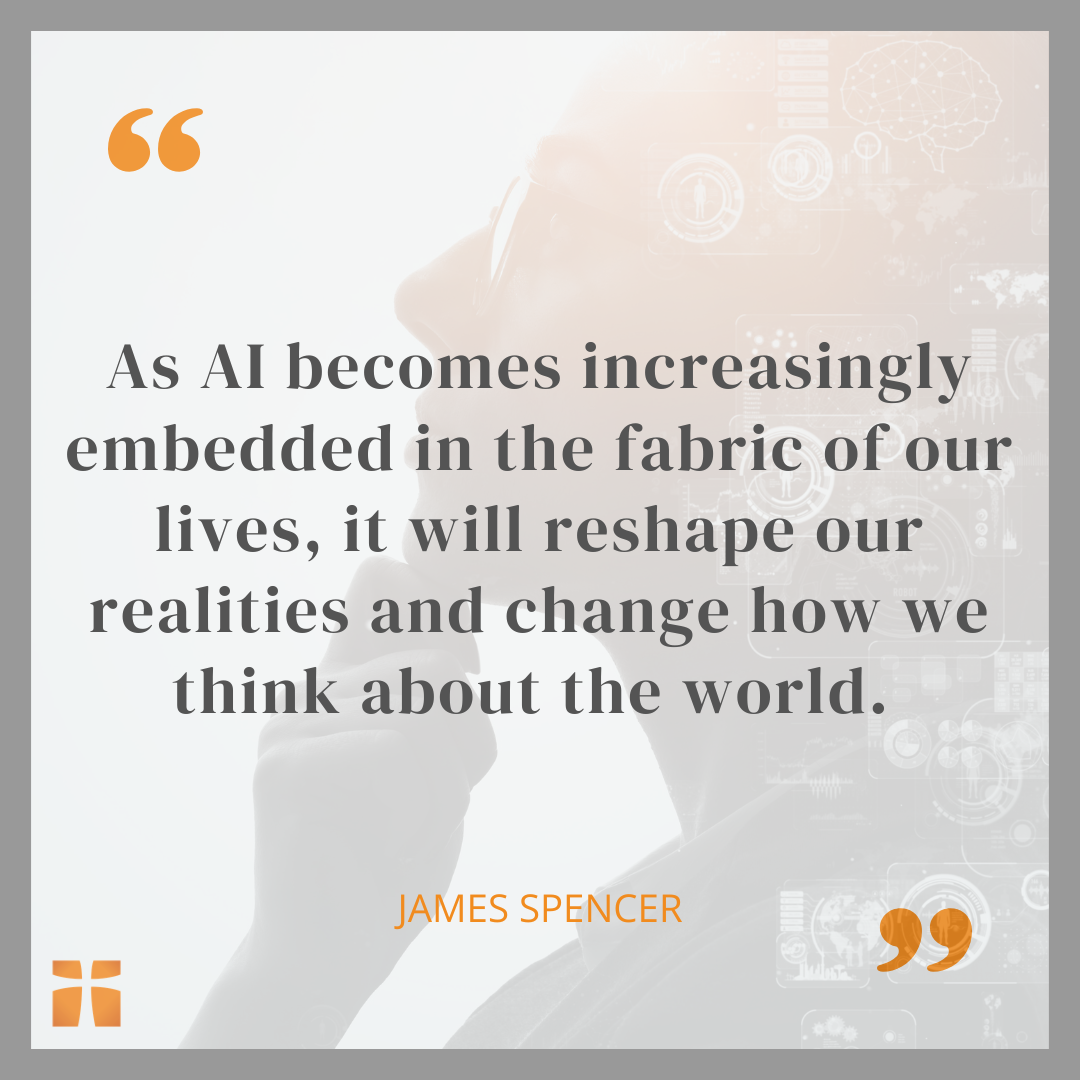
The worries practicing Christians report are framed almost entirely in terms of substitution. Another 2026 Barna report demonstrates that they are concerned that AI will misinterpret Scripture (83%), replace God (72%), or displace pastors and spiritual leaders (72%). Even the concern that AI will cause people to lose their faith suggests a sort of substitution (73%). If we think of substituting AI for other resources for interpreting scripture, for God, or for pastors, as a decision, it seems clear that it is a decision practicing Christians have no intention of making. Still, we don’t always intend to go where we end up. The danger is not that practicing Christians will consciously choose to reject the Triune God or intentionally distance themselves from the body of Christ. It is that AI will alter our patterns and our perception until God and others come to seem less necessary than they are. As AI becomes increasingly embedded in the fabric of our lives, it will reshape our realities and change how we think about the world.
How Do Small Decisions Reshape Christian Habits?
To understand how our worlds are reshaped, we need to understand at least two dynamics. The first is found in economist Alfred E. Kahn’s 1966 essay, “The Tyranny of Small Decisions.” Kahn argues that an outcome no one would have selected if it had ever been offered as a single choice can emerge in a given market. While a choice might be optimal for an individual, the aggregation of those choices may be non-optimal. By the time the non-optimal outcome becomes apparent, walking back the decision becomes difficult, if not impossible.
While no Christian would decide that artificial intelligence should replace pastors or be depended upon for biblical interpretation, it is entirely possible that such an outcome could still emerge through the sum of a thousand small decisions, each of which erodes other options, resets expectations, and establishes efficiencies that push out other options. Consider, for instance, overreliance on AI. A 2026 study (“AI-overdependence and Human Cognitive Decline: Hazards, Evidence, and Mitigation Strategies”) reports an association between heavy reliance on AI and diminished higher-order cognitive performance, particularly in critical thinking, complex decision-making, and analytical reasoning. Within any single life, such an effect may be negligible. Across a population—even a Christian population—the capacities being traded away are often those necessary to the building up of the body of Christ and the faithful discernment of good and evil.
Why Does Efficiency Need Theological Discernment?
The second is described in Jacques Ellul’s The Technological Society, where he argues that societies are driven by a technical imperative. This imperative demands that whatever can be made efficient will be made efficient, and that societies eventually organize their institutions, habits, and values around techniques rather than subordinating those techniques to prior (theological) convictions and commitments. The imperatives make one way of life easier and cheaper than other alternatives, so that the alternatives no longer make sense.
While Ellul is right to highlight the technical imperative, we are not so thoroughly determined by our technical environment that resistance is futile. In Magnifica Humanitas, signed on May 15, 2026, Leo XIV declines the sort of framing that would make technology either an all-encompassing solution or an unqualified enemy. He writes,
“In the abstract, technology in and of itself is not a solution to humanity’s problems, just as it is not inherently evil. In practice, however, technology is never neutral, because it takes on the characteristics of those who devise, finance, regulate and use it. Therefore, the primary choice is not between a ‘yes’ or ‘no’ to technology, but rather between constructing Babel or rebuilding Jerusalem; between a power that claims to dominate the heavens and a people who work together in the presence of God to rebuild the walls of fraternal coexistence.”
Technology is a response to the broken relationship we inherited after the Fall. That response can point to and glorify the Triune God through service to him and his creation, or it can prompt us to love the world on the world’s terms. Adoption is never merely adoption, but a means of addressing some perceived lack of capacity. We want what technology offers and pursue it, often without considering what we must leave behind in the process.
How Can Christians Resist the Technical Imperative?
So, what do we do? How can Christians cultivate a way of viewing the world that is capable of resisting the allure of the technical imperative on a moment-to-moment basis?
Why Should Christians Embrace the Friction That Forms Us?
First, we embrace the sort of friction that forms us. Humans are embedded and embodied creatures. We get hungry, thirsty, tired, and angry. We can experience hope, joy, pain, and disappointment. Through these embodied experiences, we know the world in ways that AI never can. Like the incarnate Lord, we can learn obedience through suffering (Heb 5:8).
AI platforms like Claude and ChatGPT are optimized to accommodate us, understand our patterns, provide answers in a near-instantaneous manner, anticipate what other questions and topics we might like to explore, and summarize complex ideas. Much of the resistance and effort we might otherwise have to put forth to understand the world around us is minimized. We write a prompt and get an answer with no further obligation to read, watch, listen, or think. When we don’t wrestle with a difficult topic long enough to be confused, we are deprived of the formation that comes from effort and difficulty.
The corresponding recognition is that we aren’t built to know everything. We were made to be dependent on God, others, and creation. That limitation is not a defect, but a necessary condition that points us to what it means to be truly human. Our dependence on God, others, and creation embeds us in a matrix of relationships that allows us to serve and be served as we seek to emulate the cruciform pattern of Christ’s life.
How Can We Tell the Difference Between Helpful Efficiency and Formative Effort?
Second, we learn to distinguish the effort that complicates from the effort that forms. Efficiency is not the enemy. There are administrative and bureaucratic tasks I am happy to hand off to AI. Using AI to build a design for a presentation, to check for grammatical and spelling errors in a document, or to analyze a website’s metadata are tasks that require a fair amount of time. Offloading them to AI, particularly when I don’t have access to a human to whom I could turn for help, seems to represent a relatively minimal threat, though it is important to test that judgment in light of Kahn’s tyranny of small decisions. As such, I don’t even use AI for those tasks in every instance. I draw a hard line when conducting a literature review, outlining something I intend to write, or summarizing a body of research. Could AI handle those tasks? Perhaps, but its capacity is not the relevant question.
The distinction is not between important work and unimportant work. At times, building slides, for instance, is simply a cut-and-paste operation. Efficiency in that case may allow us to engage in more challenging tasks. Reading a journal article, wrestling with a book, or listening to a discussion between experts is a different matter. AI could summarize the conversations, but it can’t provide the benefits we get from struggling, thinking, and reflecting on a given set of material.
Why Should Christians Verify What AI Provides?
Third, we use AI only when we have a way to verify the information it provides. I would assume that most people turn to AI when they are looking for answers about a topic they don’t understand. However, anyone who has used AI to do research in a discipline in which they have domain expertise knows that AI is prone to oversimplifications that result from its necessarily abbreviated, narrowed responses. As such, AI is often most dangerous when the user has no independent means to evaluate the AI’s response.
Telling Christians to restrict AI to an area of expertise seems like it would involve abstaining from AI almost entirely. But the limitation isn’t about credentials; it’s about verification. Before accepting an AI response, it is necessary to check it. If, for instance, someone has a biblical question or wants to develop a study by using AI, that person should also be prepared to read a commentary or talk with a pastor or teacher who knows the material well. Verifying a response using multiple sources adds texture and depth to our understanding while requiring us to put in a bit more effort and thus opening us up to the formation that often accompanies it.
How Can the Church Remain the Church in the Age of AI?
Cultivating an approach to AI should involve an array of Christian theological convictions. Evangelicals are concerned (or should be) with the well-being of the whole of God’s created order. As a body that believes in the incarnation of Christ, we have (or should have) deeply rooted convictions about the importance of an embedded and embodied witness. We are not obsessed (or shouldn’t be) with information but pursue the love of God demonstrated by obedience rather than affirmation alone (cf. Jas 2:19).
Affirming such an approach is different from living it. Karl Barth insisted that the Church has its own cause and speaks its own language, and that the task before it is that “the Church shall again be the Church.” Barth wrote against a political order that offered the Church a vocabulary and a set of priorities that would make the Church subject to earthly power rather than to God. The offer on the table now comes from a system that will supply religious language on demand, optimized for fluency and for our approval. A Church that accepts this offer without qualification will likely find that it no longer has much to say that it isn’t receiving from AI.
We are capable of resisting Ellul’s technical imperative. We are subject to the Lord, and because he has a claim on us, our lives are not our own. The practices above offer ways of keeping our perception of reality grounded in the Bible and theology. We must not assume that every use of AI edifies, or that efficiency and faithfulness are always aligned. The test is whether a given use conforms us more closely to the image of the one “in whom are hidden all the treasures of wisdom and knowledge” (Col 2:3).
Frequently Asked Questions about Christians, AI, and Spiritual Formation
- Are practicing Christians using AI more than other Americans?
Barna’s 2026 research found that practicing Christians report frequent AI use in both personal life and work at higher rates than U.S. adults overall. - Why is AI a spiritual formation issue for Christians?
AI is a spiritual formation issue because repeated use can reshape habits, expectations, dependence, attention, study, and the way Christians seek wisdom. - Does using AI mean Christians are replacing pastors or Scripture?
Not necessarily. The concern is often not one dramatic decision to replace pastors or Scripture, but many small decisions that can make embodied discipleship, study, and pastoral guidance seem less necessary over time. - How can Christians use AI with discernment?
Christians can use AI with discernment by embracing formative effort, distinguishing helpful efficiency from spiritual shortcuts, and verifying AI-generated information with Scripture, trusted sources, pastors, teachers, and careful study. - What should Christians avoid when using AI?
Christians should avoid treating AI as a spiritual authority, accepting unverified answers, outsourcing formative thinking, or assuming that efficiency and faithfulness always point in the same direction.
For Further Reading
Photo Credit: ©Getty Images/doidam10

Originally published September 16, 2026.

Continue reading