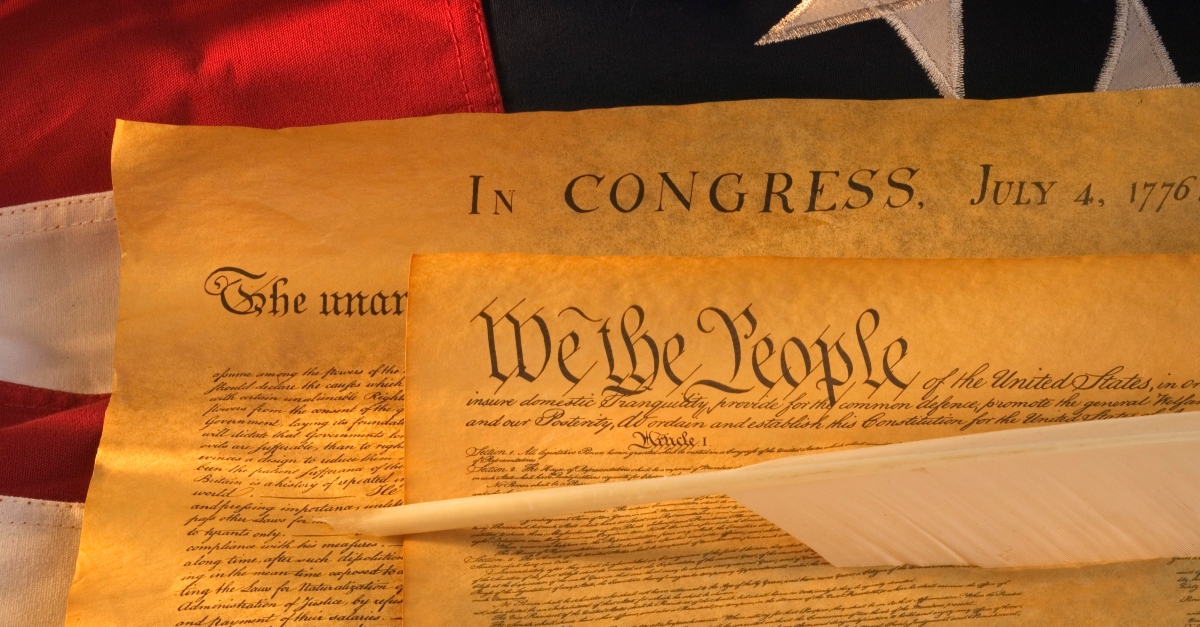
What is Constitution Day anyway? Most of us didn’t grow up celebrating it in school, although maybe schools in the United States of America would be wise to make it a big deal in our education system across the nation. Even though some calendars note it, most of us don’t recall it even being mentioned in our classrooms.
Still, it’s not too late for us to celebrate it, to pass the significance of it on to the next generations, and to explain why it’s wise to commemorate it, especially in the political climate of today’s world. After all, it’s a very momentous day in the history of the United States of America, of our foundational history and heritage.
During America’s 250th Anniversary of the Declaration of Independence, we can connect its call and influence to life, liberty, and the pursuit of happiness with the Constitution.
Bishop E.W. Jackson, Founder and President of STAND and Author of Sweet Land of Liberty, writes, “September 17, 1787, is every bit as important as July 4, 1776. It should be celebrated as one of the most important holidays of the year. The Declaration created our country, but the Constitution determined what kind of nation we would be and what kind of government we would have. My African ancestors were not included then, but we are all included now. We should all be grateful and celebrate Constitution Day, the Constitutional Republic which grew from it and the liberty we enjoy living under it.”
Officially commemorated each year on September 17, it’s known as Constitution Day and Citizenship Day, a federal observance to celebrate the signing of the United States Constitution in 1787 by the Constitutional Convention delegates in Philadelphia, Pennsylvania.
Unlike some holidays, the significance of its September 17 date remains firm year-after-year, not ever to be changed to create a 3-day holiday weekend.
History of Constitution Day
Bishop writes: “The Constitution of the United States is the most revolutionary document in the history of governance. It was a break from all that had gone before it. Some credit the Magna Carta, written over 400 years earlier, before the American Constitution, as the first guarantee of liberty. However, the Magna Carta only granted rights to the wealthy nobility.”
Once the British surrendered to General George Washington on October 19, 1781, in Yorktown, Pennsylvania, ending the Revolutionary War, as a new nation, America needed a constitution because the old Articles of Confederation were outdated.
To resolve this, on May 25, 1787, delegates gathered in Philadelphia to draft a new constitution in order to establish a federal government to serve our nation well. Although General Washington was voted as chair, the delegates were greatly divided, with some quarreling over disagreements and not being able to agree and move forward on the formation of a new government, dragging the discussion on for months.
Founding Father, eighty-one-year-old Benjamin Franklin, stepped up to take the lead amongst the arguing, divisions, and quarreling, by making a passionate motion, reminding the delegates who truly birthed America, suggesting they all look to God to lead them.
“In this situation of this assembly, groping, as it were, in the ark to find political truth, an scarce able to distinguish it when presented to us, how has it happened sir, that we have hitherto once thought of humbly applying to the Father of Lights to illuminate our understandings? In the beginning of the contest with Britain, when we were sensible of danger, we had daily prayers in this room for the divine protection. Our prayers, sir, were heard—and they were graciously answered.”
Franklin’s impassioned plea continued with, “All of us, who were engaged in the struggle, must have observed frequent instance of a superintending Providence in our favor. To that kind Providence we owe this happy opportunity of consulting in peace on the means of establishing our future national felicity. And have we now forgotten that powerful friend?….I have lived, sir, a long time; and the longer I live, the more convincing proofs I see of this truth, that God governs in the affairs of men! And if a sparrow cannot fall to the ground without His notice, is it probable that an empire can rise without His aid? We have been assured, sir, in the sacred writings, that “except the Lord build the house, they labor in vain that build it.”
Taken from Psalm 127:1, Franklin was referring to, “Unless the Lord builds the house, the builders labor in vain. Unless the Lord watches over the city, the guards stand watch in vain.”
Ultimately, Franklin’s interjection into the discussion, led to the writing of the United States Constitution, through General Washington leading the delegates to a prayer service at Philadelphia’s Reformed Calvinist Lutheran Church with the Rev. William Rogers, who led them all to pray together, “The Lord’s Prayer,”
Jackson writes, “The delegates sat in sweltering Philadelphia summer heat for nearly four months, and what emerged was the most successful governing constitution in human history.”
The Strengths and Safeguards Written Within the United States Constitution
Adopting the constitution was critical to the future of our nation, designed to prevent a one-person ruler, keeping a president from ruling solely through mandates and executive orders.
The U.S. Constitution is deliberately structured to restructure the concentrated power of a King by separating it into three branches, pitting each against the other, in order to create a tug-of-war capable of keeping power in check, while setting up citizens to be co-rulers in America, with each person in charge of their own lives and working together as one in charge of our nation.
As well, in the current political climate, Citizenship Day recognizes the responsibilities and rights of U.S. citizenship, which are of the utmost importance for our nation to flourish, prosper, maintain our God-given freedoms through ongoing challenges, and ultimately survive.
Although the United States is often mistakenly referred to as a democracy, it is in fact, a republic, as stated in our nation’s pledge of allegiance: “I pledge alliance to the flag of the United States of America, to the Republic for which it stands, one nation under God, indivisible, with liberty and justice for all.”
William J. Federer, author, historian, and co-author of Who Is the King in America? writes how important it is to point this out and to correct America’s misunderstanding concerning it, because, “A ‘constitutional’ republic limits representatives with a set of rules approved by the citizens. Where democracies are susceptible to being whipped into a frenzy, allowing a majority to carry out sudden mob justice, constitutional republics are slower to change, especially when they have the goal of guaranteeing citizens their Creator given rights.”
As Matthew 12:25 explains, it’s so important for the United States of America to be unified. “Jesus knew their thoughts and said to them, ‘Every kingdom divided against itself will be ruined, and every city or household divided against itself will not stand.’”
“Will the Constitution withstand the latest challenges by Democratic Socialists of America who want to throw out the Constitution and eliminate the Presidency, the US Senate and the Electoral College?” asks Bishop.
It took months to write but in the end, Federer writes, “America’s founders designed a government that was intentionally slow to change—frustratingly slow at times in making good changes but thankfully slow in making irreversible bad changes.”
Why the Constitution Matters
The Constitution is the foundation of our nation, establishing our God-given rights. It’s vitally important for us as United States citizens to recognize and remember how America was founded and established, and to remember as a nation, to set times aside to glorify God for His leadership in its founding and existence.
“Our Constitution secured individual liberty to every American, such that no one can take it away,” writes Bishop. “The Declaration established that liberty and fundamental rights are God’s gifts to mankind. The Constitution secures those rights and sets limits on the power of government to take them away.”
Photo credit: ©Getty Images/Tetra Images
Lynette Kittle is married with four daughters. She enjoys writing about faith, marriage, parenting, relationships, and life. Her writing has been published by Focus on the Family, Decision, Today’s Christian Woman, kirkcameron.com, Ungrind.org, StartMarriageRight.com, and more. She has a M.A. in Communication from Regent University and serves as associate producer for Soul Check TV.
Originally published September 17, 2026.