Listen or Read Below:

Audio By Carbonatix
Brought to you by 
Key Points
- A biblical worldview should shape more than how Christians vote; it should influence how they seek truth, treat others, and participate in public life.
- Scripture does not directly command voting in a modern democracy, but it gives Christians principles for seeking the welfare of their communities, pursuing justice, and praying for leaders.
- Christian civic engagement requires careful attention to facts rather than automatically trusting the loudest political voice or preferred party.
- Party affiliation does not determine whether someone belongs to Christ, and political loyalties should remain answerable to Scripture.
- Christian responsibility continues after election night through prayer, community involvement, informed participation, truthfulness, and care for people affected by public decisions.
On election night, a television studio in Fort Worth, Texas, will be full of people watching the same returns that millions of Americans can watch from their couches. They will have driven miles to get there and chosen to experience the evening together, much as we all should — as a nation united.
In a country where we can follow an election without putting on shoes, the decision to stay active and involved in civic life, simply by knowing what is happening beyond “who won,” interests me. In fact, it should interest all Christians, everywhere.
On Nov. 3, America Stands, produced by the Victory News Division of VICTORY Channel, a nonprofit Christian television network affiliated with Kenneth Copeland Ministries, plans to bring a live audience into a Dallas–Fort Worth studio for election returns, analysis, commentary, and prayer. It could be argued that this is a novel undertaking for something that should have been done all along.
Here’s the difference from all national TV programming on Election Night: The program approaches elections through a biblical worldview. Analysis that aligns with the Bible. People who love God and want His Spirit to touch us all. And results, regardless of “who wins,” will be discussed openly, transparently, and spiritually.
Of course, sitting in a television studio doesn’t establish anyone’s civic virtue. Someone watching at home may have spent the afternoon volunteering at a polling place. Others may have discussed with anyone they could, hoping passersby would give their candidate a chance. And a few people (like most of us) may have just had a conversation about their coffee preferences in the break room.
From the school board to the U.S. Senate, many decisions will be made on Election Night. The question, at least in the minds of Christ followers everywhere, is “What would God have me to do?”
Still, those occupied chairs on Election Night raise a question that reaches well beyond a broadcast: How willing are believers to be present and active in the civic life of the country we call home?
For Christians who have the opportunity to participate in civic life, voting can be one meaningful place to begin. But Scripture’s vision of faithfulness extends far beyond the ballot box.
What Does Showing Up Actually Mean?
Before the 2024 presidential election, research directed by George Barna found that 79% of American adults qualified for its broad “people of faith” category. Those included people identifying with Christianity and other religions. Among that group, only 51% were classified as likely to vote.
“We love God and believe He created this world to be our dominion, but meh…voting is for other people.” Excuse me, what?
Those figures measured anticipated participation in 2024. They weren’t a count of Christians who ultimately stayed home, and they aren’t a forecast for this election. It shows something much deeper that exists in this country, and primarily among Christians.
Apathy.
A separate 2024 post-election survey by Arizona Christian University’s Cultural Research Center reported that 56% of self-identified Christians voted. That was a survey finding, rather than an official count of voters’ religious identities. Even with that distinction, the gap between identifying with a faith and participating in an election deserves attention.
So does the question behind it. Disillusionment, conscience, practical obstacles, and apathy differ in meaning and in their relation to self-actualization. An empty place, a seat in a studio, or a polling booth tells us someone is absent; it doesn’t tell us why.
But when we can participate and choose not to be bothered, something is worth examining. Public decisions reach people we are commanded to love: the children in our schools, the families struggling with rent, the neighbor waiting for emergency services, or the teen mother at the clinic desperate for help.
Jesus’ command to love our neighbors has consequences for how seriously we take their lives (Matthew 22:37–40). The thing is that a ballot is only one way our decisions can reach them. These are times when our behavior must align with our convictions. And that includes what we do and what goes on inside the polling place.
Why Would God Tell Exiles to Care about Babylon?
Jeremiah’s followers and disciples had considerably more reason to resent their surroundings than most of us do. These were people carried away from Jerusalem into Babylonian exile.
Weren’t we talking about elections and people taking part in a Fort Worth TV studio? Yeah, but here’s where they and the exiled people of God in 605 BC differ: They hadn’t selected their government, approved its policies, or volunteered for relocation.
God’s instruction through Jeremiah was startlingly practical: build houses, plant gardens, raise families, and seek the welfare of the city. They were also to pray for it, because their welfare was bound up with its welfare (Jeremiah 29:4–7).
The Hebrew word translated as “peace” or “welfare” is shalom. In this passage, the concern reaches into the conditions of shared life. Their neighbors’ flourishing mattered even in a place that wasn’t home.
Jeremiah wasn’t writing instructions for an American election. We should let his letter remain a letter to exiles before drawing a modern application from it. Yet its challenge travels: estrangement from a government doesn’t erase responsibility toward the people living under it.
Americans have opportunities that those exiles lacked. We can help choose leaders, question them publicly, organize with our neighbors, and seek changes in law. Gratitude for those freedoms can become a reason to use them carefully.
There is room here for love of country, including pride in being an American. Such love can make us attentive to our country’s wounds and willing to help repair them. Seeking its welfare requires enough honesty to recognize what needs work.
How Should a Biblical Worldview Shape the Way We Get Informed?
Back in the studio on Election Night, the audience will watch numbers change and listen as contributors explain what they mean—to parties, to voters, but mainly, to believers. That unique quotient in the entire process that unfolds should make Christians stand out for what to do in this country and stand up for what’s right despite it.
Election coverage makes attention feel urgent. The harder question is whether we bring that attention to the decisions that precede and follow an election.
The Book of Proverbs has an uncomfortable amount to say about how we form opinions. It calls answering before listening folly and shame (Proverbs 18:13). A few verses later, it observes how convincing the first account can sound until another person examines it (Proverbs 18:17).
Apparently, the problem predates Facebook.
These proverbs weren’t written about campaign advertising, but their wisdom applies readily. A biblical commitment to truth should affect whether we read past a headline, believe one of those blowhard TV ads, or examine evidence that complicates a claim we wanted to believe.
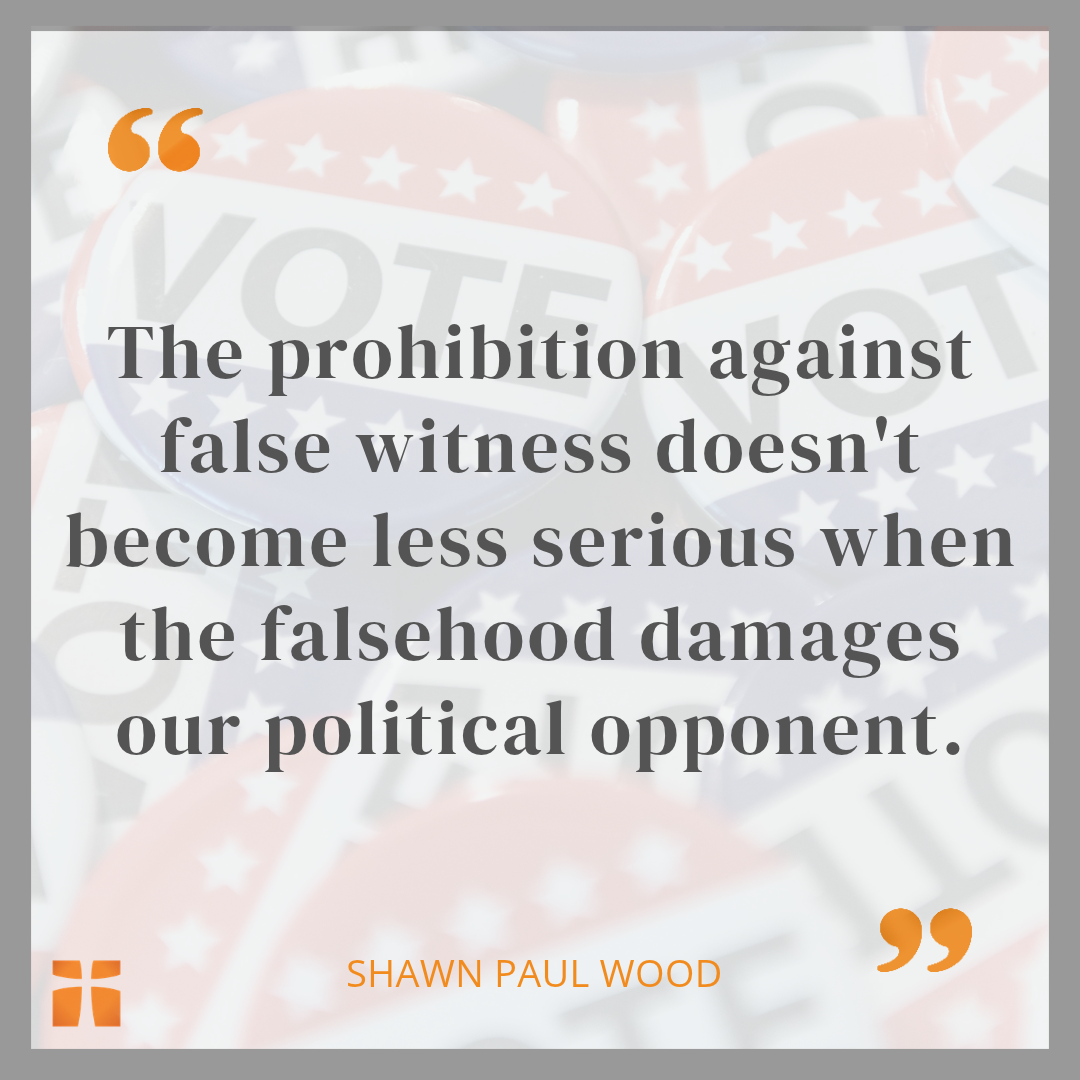
The prohibition against false witness doesn’t become less serious when the falsehood damages our political opponent (Exodus 20:16). Sit with that for a moment. Just because you don’t like the particular hue of some candidate’s tie or blouse doesn’t mean at all that this person is no less deserving of God’s grace or love.
Proverbs 18:15 describes discerning people as those who acquire and seek knowledge. That is active work. It leaves little room for treating the loudest voice or the dumbest commercial in our feed as the best-informed person in the room.
Civic knowledge also means understanding which public office can address the problem concerning us. This is the primary reason why having a biblical worldview matters most, or at least, should. A school board, a city council, a state legislature, and Congress have different responsibilities. Anger directed at an official who lacks the authority to resolve a problem may produce an excellent rant. It rarely produces a solution. God has the answers. It’s up to us to ask the right questions.
Reading a proposal, examining a candidate’s record, or listening to a public meeting can be tedious. Yet these are ways to discover what a decision might mean for actual people. If that reminds you of anything, consider that next Sunday.
Can Biblical Conviction Survive Party Loyalty?
Democrats can be Christians. Republicans can be Christians. So can independents and people who wish the entire campaign would stop texting them.
Party registration cannot establish whether someone belongs to Christ. Nor does calling a position biblical settle whether we have understood Scripture or applied it faithfully.
The Bible gives us substantial moral responsibilities.
-
Human beings bear God’s image (Genesis 1:26–27).
-
We are called to justice, mercy, and humility (Micah 6:8)
-
And we speak for people whose voices are easily ignored (Proverbs 31:8–9).
Those convictions reach into debates about unborn life, poverty, public safety, immigration, education, and the treatment of vulnerable people.
Naming those concerns together doesn’t make every policy equally sound or every disagreement morally trivial. Abortion carries profound questions about the protection of human life. Other public decisions also carry consequences for people made in God’s image.
Believers can share a moral concern and disagree about which policy will address it effectively. Sometimes disagreement exposes a mistaken interpretation, an unsupported claim, or a serious moral failure. Sometimes it concerns the practical consequences of competing proposals. Understanding the disagreement takes more effort than assigning someone a spiritual diagnosis based on a yard sign.
A biblical worldview should make our political loyalties answerable to Scripture. We need enough independence to question our preferred candidate, acknowledge wrongdoing among our allies, and recognize a sound argument from someone we usually oppose.
What Happens after Everyone Goes Home?
Eventually, the studio audience will leave. The lights will dim, the chairs will empty, and election coverage will give way to whatever comes next on the schedule.
Elsewhere, public life will continue in less dramatic rooms. A city council will consider a budget. A school board will hear from parents. A neighbor will need help navigating a public service. An elected official will make a decision worth questioning—or supporting.
These settings seldom offer the suspense of election night. They do offer opportunities to seek the welfare of the place where we live.
-
Paul urges prayer for rulers so people can live peaceful, godly lives (1 Timothy 2:1–2).
-
Peter connects honoring others and respecting governing authority with fearing God (1 Peter 2:17).
-
When authorities demand disobedience to God, the apostles establish the higher obligation plainly (Acts 5:29).
Together, these passages leave room for prayer, respect, scrutiny, and principled resistance. They also make it difficult to treat government as someone else’s concern until the next campaign advertisement interrupts dinner.
A biblical worldview becomes visible in ordinary conduct: the care we take with facts, the dignity we extend to opponents, the attention we give our communities, and the willingness to act when our neighbors need us. Voting belongs within that life of responsibility. It cannot carry the whole weight of it.
The people gathering for America Stands will have chosen to be present. Their example raises a worthwhile Election Day question about the rest of us.
The more enduring question is what happens when everyone gets up and goes home.
Frequently Asked Questions
Does the Bible Command Christians to Vote?
The Bible does not directly command participation in modern democratic elections. Christians can, however, apply biblical principles of stewardship, justice, love for others, truthfulness, prayer, and seeking the welfare of their communities to civic participation.
What Does a Biblical Worldview Mean in Politics?
A biblical worldview makes political beliefs and loyalties answerable to Scripture rather than allowing a political party, candidate, or ideology to become the Christian’s final authority.
What Does Jeremiah 29 Teach about Civic Life?
Jeremiah instructed Judean exiles in Babylon to seek the welfare of the city where they lived and pray for it. The passage was not written about democratic elections, but it provides a biblical pattern of caring about the well-being of the wider community.
Can Christians Belong to Different Political Parties?
Yes. Political affiliation does not determine salvation or membership in Christ. Christians may share biblical convictions while disagreeing about how particular policies apply those convictions.
What Should Christians Do after Election Day?
Christians can continue praying for leaders, learning about local issues, speaking truthfully, serving their communities, advocating for people in need, and holding public officials accountable without making politics their ultimate hope.
For Further Reading
Photo Credit: CANVA/election day

Originally published November 03, 2026.