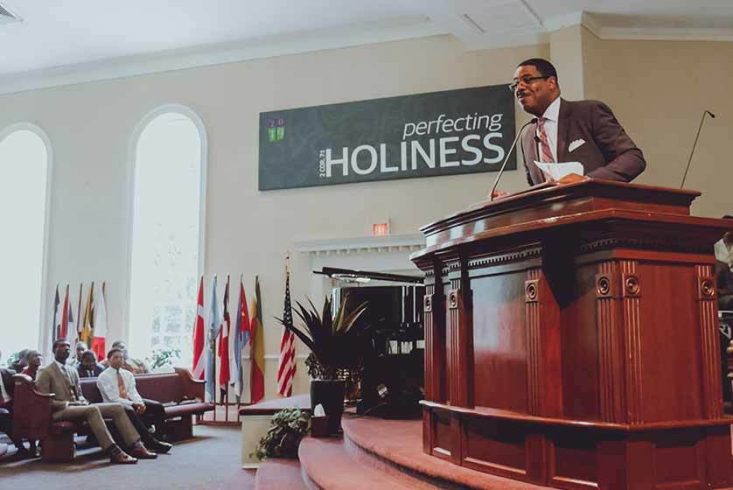

When Martin Luther King Jr. led the peace march in response to Bloody Sunday, he paused with the people on the Edmund Pettus Bridge to kneel and pray. At the site where the civil rights protesters had been brutally attacked, he raised requests for the oppressed and abused. Those prayers, and the countless others prayed by people around the country and the world, contributed to the peaceful resistance against the violence and racism that inundated American society.
King strongly believed Jesus’ words that returning evil for evil was futile, and he maintained a regular prayer practice. As he prayed during a speech, “God grant that right here in America and all over this world, we will choose the high way; a way in which men will live together as brothers. A way in which the nations of the world will beat their swords into plowshares, and their spears into pruning hooks. A way in which every man will respect the dignity and worth of all human persons.”
King’s actions as a pastor and civil rights leader were inseparable from his prayer life since a praying Christ-follower is inevitably a fruitful one. Likewise, we should not underestimate the power of prayer in fighting injustice. Peace, in our lives and in the world, starts with a relationship with the Prince of Peace (Isaiah 9:6). As we pray, allowing the Lord to transform our attitudes toward others, we become greater agents of love in the world, loving those who curse us and seeking the good of those labeled as our enemies (Luke 6:27-28; 1 Peter 3:9).
By harnessing current technology that enables believers to pray around the world, we can inspire action against violence and war. To seek the “high way,” as King said, and imitate Christ by encouraging one another toward self-giving love and sacrifice. Never has the world been so connected; may we use that digital connection to “seek peace and pursue it” (Psalm 34:14, NIV).
What Are Digital Prayer Spaces?
If the internet is akin to a digital meeting place, then the prayer spaces found there are like online prayer rooms or closets. There, users can post and view prayer requests, tune in to scheduled meetings, and join others in prayer. Some churches and groups have even started prayer walls, circles, and around-the-clock teams that intercede for others’ requests. These are not passive spaces, but ones that invite individuals to talk to the Lord and add their voices to the countless others who are seeking His help and will.
Although these places can be found on a screen, many are often extensions of physical prayer spaces that mirror what is done online. Organizations and churches have long encouraged the creation of prayer rooms and places in churches where Christ-followers can retreat to commune with the Lord. Like their digital counterparts, these are areas that encourage action and participation in the community. Individuals can get away for a time, away from distractions, to return refreshed and reoriented toward God’s purposes.
How Can Christians Use Technology for Good Instead of Division?
The internet has often been weaponized for hatred and lies. In today’s world, it is easy to become overwhelmed by the constant onslaught of opinions and problems online. We can find ourselves caught in a war over our thinking, as philosophical and political lines encourage us to join their side, absorbing their contempt for those who disagree with them. Yet those who use their digital presence in these ways usually find themselves drained and dissatisfied. In fighting the “enemy” through posts and reels, they use the same tactics they claim to be against.
But what if the same medium used to encourage people to hate their neighbor and act violently could instead be used to promote peace? Online prayer meetings and sites can do just that, bringing people together with a shared love of Jesus to seek the good of others in the world.
The weapons of the world are not the ones the church wields. As the Apostle Paul wrote, “The weapons we fight with are not the weapons of the world. On the contrary, they have the divine power to demolish strongholds. We demolish arguments and every pretension that sets itself up against the knowledge of God, and we take captive every thought to make it obedient to Christ” (2 Corinthians 10:4-5, NIV). As we pray and submit to the Lord, allowing Him to transform our thinking, we will find that instead of throwing stones at others, we can pray for them, asking God to help us love those with whom we disagree. In turn, we can pray that the same Christlike love that touches us can fill the lives of others.
Using technology for good instead of evil allows us to dismantle what is often used as a weapon. As St. Athanasius of Alexandria wrote: “Christians, instead of arming themselves with swords, extend their hands in prayer.”
How Can Christians Use Technology for Good Instead of Division?
Skeptics of the effectiveness of prayer to change situations and people often point to its misuse. Most of us know of the pinch of pain that comes when someone shrugs off our struggles with a simple, “I’ll pray for you.” A soulless response that comes automatically without any intention to pray or act. We also mourn the times when we have carelessly spoken those same words in an effort to hurry on with our day or get through a difficult interaction.
No, robotic phrases will not make a difference. Our Lord does not approve of empty words (Matthew 6:7; 12:36). Rather, He desires our wholehearted relationship.
How Prayer Moves Christians Toward Peacemaking
Some may continue to doubt whether praying can contribute to the fight against injustice, violence, and war. What do our prayers matter when individuals are killed in an attack, or when people face oppression? Should we not be doing something useful instead?
If we view prayer only as a passive act that makes no difference, then prayer seems like the last thing we should do. But in reality, prayer is powerful, not only because it is effective (James 5:16), but also because it has the power to change hearts. We pray for peace as God begins to work in our lives, urging us to serve as peacemakers in our communities and beyond. In other words, our prayers grow to become actions.
Merely saying that we will pray for those affected by the war or that we are “sending” them good thoughts will not accomplish anything. Rather, when we commit to seeking God’s will and pray that compassion would replace hatred, we can make a difference––in our attitudes and perspectives, as well as in the lives of others. For then, we will be dedicated to obeying the Lord, to “act justly and to love mercy and to walk humbly with your God” (Micah 6:8, NIV).
How Can Christians Use Technology for Good Instead of Division?
In addition to connecting with a local church’s digital prayer space, many organizations and ministries exist to promote prayer in an online format. Individuals can visit sites like InPrayer that offer a focused place to pray without the distraction of any screen, whether on a laptop or phone. Other websites, such as Sacred Space, provide structured daily prayer that can serve as a starting point for intercession against violence and oppression.
You can go to Crosswalk Forums, where you will find a category for sharing your prayers and be able to pray for others.
To start a group focused on praying for peace, there are multiple resources online to create a prayer space, both in-person and online. For example, 24-7 Prayer has a guide, “Pray for Peace and an End to War,” which can be adapted to specific contexts. They also offer resources for starting a virtual prayer room.
Compiling Bible verses to meditate on during these digital prayer meetings is another crucial resource for praying for the end of war. Key verses related to violence, oppression, and war can direct our thoughts as we intercede for our neighbors across the world:
-
Isaiah 2:4: “He will judge between the nations and will settle disputes for many peoples. They will beat their swords into plowshares and their spears into pruning hooks. Nation will not take up sword against nation, nor will they train for war anymore” (NIV).
-
Matthew 5:9: “God blesses those who work for peace, for they will be called the children of God” (NLT).
-
Matthew 5:44: “But I say to you, love your enemies, bless those who curse you, do good to those who hate you, and pray for those who spitefully use you and persecute you” (NKJV).
As war rages on and tensions rise, the church can come together to pray and promote love for our neighbor. Instead of violence, we can offer a helping hand. Instead of hurtful words, we can offer the gospel of peace. And instead of fanning the flames of war, we can choose the hard but healing path of mercy.
So, may we take a medium that has been used for division and turn it into a catalyst for prayer.
And as we pray, may God make us people who do not merely ask for peace, but actively become instruments of His peace in the world.
Frequently Asked Questions about Digital Prayer Spaces and Peacemaking
- What are digital prayer spaces?
Digital prayer spaces are online places where believers can share requests, join prayer meetings, pray with others, and intercede for needs around the world. - Can online prayer lead to real action?
Yes. When prayer is sincere, it can change hearts, shape attitudes, and move Christians toward mercy, peacemaking, service, and courageous love for others. - How can Christians use technology for peace?
Christians can use technology to gather for prayer, share needs, encourage peacemaking, resist hateful narratives, and point others toward Christ’s way of love. - Why is “I’ll pray for you” sometimes misunderstood?
The phrase can feel empty when it is used to avoid action, but sincere prayer seeks God’s will and often leads believers to serve, speak, give, forgive, or pursue peace. - How should Christians pray during violence and war?
Christians can pray for peace, justice, protection, repentance, comfort for victims, wisdom for leaders, and hearts transformed by the love of Christ.
For Further Reading
Photo Credit: ©GettyImages/Jose Luis Pelaez Inc


Originally published July 29, 2026.