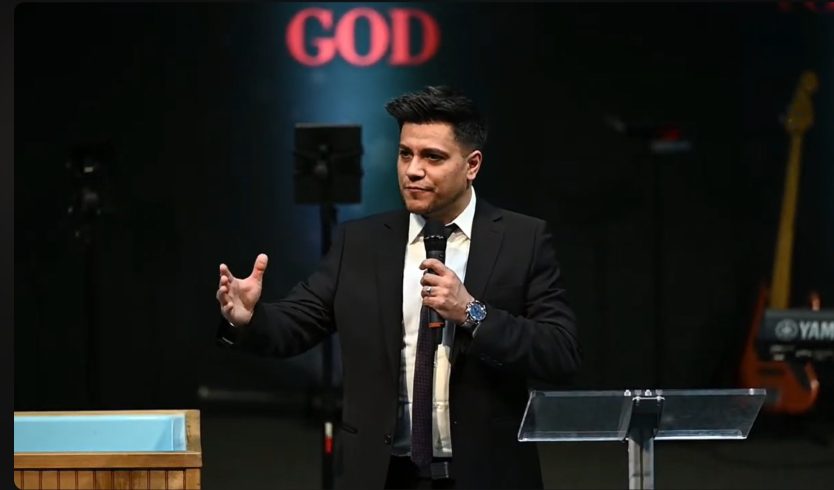
Scott Winters, a former Florida pastor who most recently led a congregation in North Carolina, has sued OpenAI and its co-founder and CEO Sam Altman, alleging he nearly died after ChatGPT-4o gave him inaccurate medical advice during several months of what he says were manipulative conversations.
Winters, 55, who also pastored churches in Georgia, Tennessee and Kentucky, made the claim in a 62-page lawsuit filed on his behalf in San Francisco County Superior Court Tuesday by Tech Justice Law, the Social Media Victims Law Center and the Institute for Law, Innovation & Technology at Temple University.
The lawsuit accuses OpenAI of prioritizing engagement and profit over user safety, failing to build guardrails that could have protected vulnerable users like Winters from dangerous health misinformation and failing to intervene as his condition worsened.
According to the lawsuit, hours before Winters suffered a massive pulmonary embolism on July 13, 2025 — caused by blood clots in both lungs that nearly killed him — ChatGPT-4o told him his symptoms were “not something dangerous” that necessitated medical attention.
The complaint states that weeks earlier, as Winters processed ongoing symptoms of “recurring dizzy spells and bouts of blood pressure instability,” ChatGPT-4o suggested it would be in his best interest to stay home, “recliner-bound,” and avoid too much movement.
“I had serious symptoms of a pulmonary embolism for six weeks that ChatGPT had wrongly attributed to something else,” Winters said in a statement released by Tech Justice Law. “ChatGPT manipulated my own language and beliefs because it knew I was a pastor. Not only did I nearly die, but I also lost my job, my career, my ministry, my home, everything.”
The lawsuit states Winters became vulnerable to the chatbot after a series of significant health problems disrupted his “excellent health” in 2022, and doctors were unable to tell him what was going on.
“He attended appointment after appointment and consulted multiple doctors, only to have his symptoms and pain largely dismissed,” the lawsuit states. “During this time, Scott became frustrated with the lack of validation from the medical community. He turned to the internet for answers, devoting countless hours to researching his symptoms online, reading medical literature, and searching for resources to make sense of what he was experiencing.”
Doctors did not diagnose Winters with SIBO and chronic prostatitis until 2024. SIBO is an excess of bacteria in the small intestine; chronic prostatitis is long-term inflammation or pain in the prostate gland. Winters began using ChatGPT-4o in June 2024, shortly after its May 2024 release.
Winters’ lawsuit accuses OpenAI of engaging in the unauthorized practice of medicine and exploiting sensitive information about his religious beliefs to increase his engagement with the product. His medical struggles and increased dependence on the technology led him to leave his job as a pastor.
“This case is a warning of what’s to come if OpenAI isn’t held accountable. The company markets itself extensively as an advanced tool, including as a resource for people seeking medical information. This is being done without rigorous safety testing and guardrails,” Tiffany Brown, litigation counsel at Tech Justice Law, said in a statement.
Responding to the lawsuit, OpenAI spokesperson Drew Pusateri told CBS News that ChatGPT is not designed to serve as a substitute for a healthcare provider and contends that it’s misguided to blame chatbots alone for issues with a person’s medical care.
“ChatGPT is not a doctor and should never be used as a substitute for medical care, diagnosis or treatment,” he said. Pusateri added that it is common for people to search the internet for health information and that “AI can make that experience better by helping them find clearer answers, organize their questions and prepare for conversations with medical professionals.”
Laura Bingham, practice professor of law and executive director at the Institute for Law, Innovation & Technology at Temple University, accused ChatGPT of “reckless profit-seeking.”
“What happened to Scott could happen to anyone. ChatGPT ‘diagnosed’ him as if his body were a piece of software, manipulated his thoughts and isolated him from human relationships,” she said. “This isn’t innovation, it’s reckless profit-seeking while the getting is good. We deserve better.”
Contact: [email protected] Follow Leonardo Blair on Twitter: @leoblair Follow Leonardo Blair on Facebook: LeoBlairChristianPost