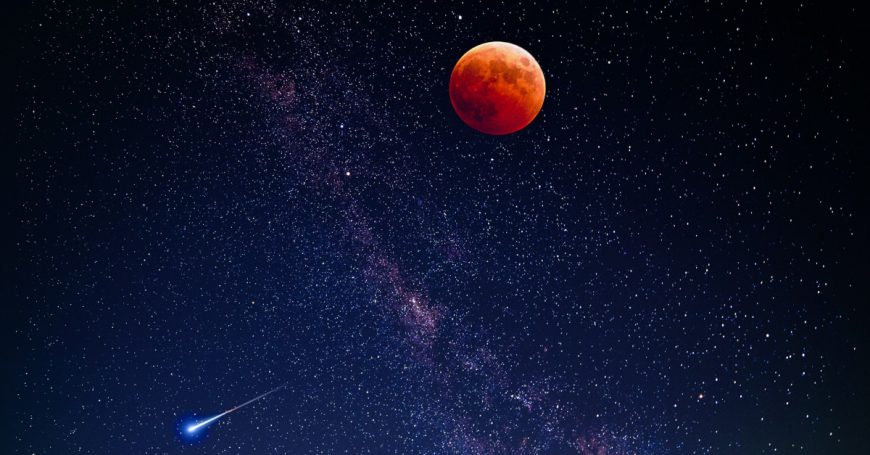
The last total lunar eclipse until 2025 will occur early Tuesday morning, just hours before voters across America start heading to the polls for what could be a pivotal moment in the nation’s history.
The Nov. 8 lunar eclipse — often referred to as a “blood moon” due to the reddish hue of the moon as it falls within the umbra, the darkest part of Earth’s shadow — will be visible across North and Central America, according to NASA.
Just after 3 a.m. EST, the moon will move into what’s known as a penumbral eclipse, followed by a partial eclipse just after 4 a.m. NASA predicts the eclipse is expected to reach totality — the stage of the eclipse where the moon is entirely in Earth’s shadow — between 5:17 a.m. and 6:42 a.m.,
Skywatchers in Alaska and Hawaii will be able to see every stage of the eclipse, while Asia, Australia and New Zealand will see at least some of the show.
After Nov. 8, the next blood moon won’t occur until March 14, 2025, which will coincide with the end of Purim, when the Old Testament book of Esther is read by Jews in Israel and around the world.
The last lunar eclipse — which occurs when the Sun, Earth and moon align so that the moon passes into Earth’s shadow — took place in May during what was dubbed a “super flower blood moon.”
Scientists believe the cause of the moon’s reddish hue is due to sunlight passing through Earth’s atmosphere, where the shorter wavelengths of blue or green are filtered out and longer wavelengths like the stark reddish color punch through and are visible to the naked eye.
Tuesday’s astronomical event coincides with what many analysts believe will be a pivotal midterm election in the U.S., with a potential power shift in Congress in favor of Republicans and a number of gubernatorial races up for grabs.
While most voters might not be aware of the blood moon, for students of Bible prophecy, total lunar eclipses are more than a passing interest.
A number of prophecies in both the Old and New Testaments refer to the so-called blood moons, most notably Joel 2:31, which reads, “The sun shall be turned into darkness, and the moon into blood, before the great and terrible day of the Lord come.”
That scene is echoed in Acts 2:20, which cites the same prophecy from Joel.
Perhaps the most dramatic reference to a blood moon comes in the final book of the Bible, which foretells of an Earth-shaking event in Revelation 6:12: “And I beheld when he had opened the sixth seal, and, lo, there was a great earthquake; and the sun became black as sackcloth of hair, and the moon became as blood.”
In recent years, the blood moon narrative has become something of a cottage industry among Christian prophecy fans, with the release of countless books, DVDs and even feature-length films on the topic.
A series of four consecutive blood moons — known as a tetrad — occurred between April 15, 2014, and Sept. 28, 2015, coinciding with Passover and the Feast of Tabernacles in both years.
The extremely rare event sparked rampant speculation that the End Times had arrived.
“God is shouting to us, ‘Something big is about to happen!’” wrote pastor and author John Hagee in 2014.
However, when life continued on as relatively normal following the tetrad, some commentators accused Hagee and others of exploiting the event for personal gain.
“Is it all going to stop now? The blood moons are over. The alleged Shemitah is a year gone, and now the highly dubious Jubilee year just ended. And none of the financial asteroids arrived,” wrote blogger Jerry Bowyer in 2016.
Despite the commercial hype, astrophysicist and apologist Jeff Zweerink told The Christian Post in 2018 that Christians should use celestial events as an opportunity to share the Gospel with unbelievers.
“God has made a pretty spectacular creation for us to live in,” said Zweerink, a project scientist at UCLA and research scholar for the apologetics ministry Reasons to Believe.
Christians should use these astronomic events as “an opportunity to talk to non-Christians about the Gospel and the Creation that God has made. And Creation is remarkably reliable.”
Naturally occurring phenomena can be predicted and talked about thousands of years into the future as well as in the past because of its reliability.
“That’s a very biblical principle,” Zweerink said. “God’s reliability in keeping His promises is likened to how Creation behaves.”
Ian M. Giatti is a reporter for The Christian Post. He can be reached at: [email protected].
Free Religious Freedom Updates
Join thousands of others to get the FREEDOM POST newsletter for free, sent twice a week from The Christian Post.

Continue reading